Saturday, 2 February 2013

COLOUR

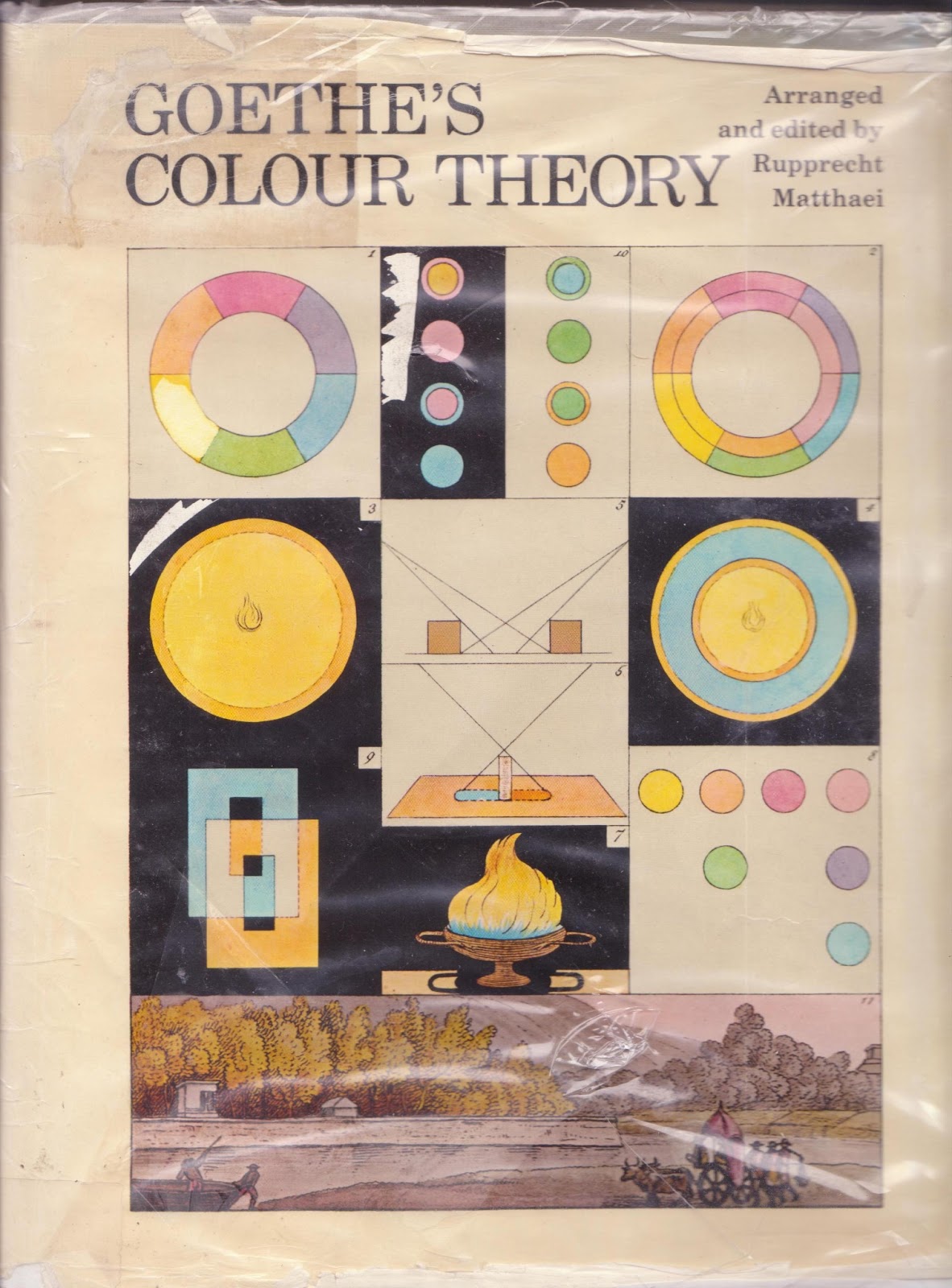
Goethe's theory of colours being metaphorical. Associating Red with the beautiful, orange with the noble, yellow to the good, green to the useful, blue to the mean, and violet to the unnecessary

The Art of Color: The Subjective Experience and Objective Rationale of Color

Itten defined and identified strategies for successful colour combinations. He devised seven methodologies for coordinating colours utilising the hue's contrasting properties. 
1. Contrast of Hue 
2. Light-Dark Contrast 
3. Cold-Warm Contrast 
4. Complementary Contrast
 5. Simultaneous Contrast
 6. Contrast of Saturation
 7. Contrast of Extension


A list of colours and how they are often used symbolically:

Yellow - light giving, gold symbolising the beyond, sun and light, understanding, knowledge. Pale yellow shows envy, betrayal, falseness, doubt, distrust and unreasoning.
Red- red-orange is dense and opaque showing fiery strength, an expression of belligerent passion, red orange on black is a unconquerable demonic passion. Red-purple connotes spiritual love. Red on lemon yellow is a dark subdued force. Red on dark pink is a quiet extinguishing heat. Red on brown flares with a dry heat.
Blue- blue is always passive from the point of view of material space but is active in terms of spiritual immateriality. In many cultures, blue symbolises immortality. Dimmed or darkened blue falls into superstition, few and grief.
Green - green gives the impression of fruitfulness, contentment, and hope. Greyed green has a sense of sad decay. Yellow greens have a feel of a young vigorous force of nature.
Orange - Maximum radiant activity, proud external ostentation.
Violet - colour of the unconscious, mysterious, impressive and sometimes oppressive. Purple also represents royalty. Light violet gives a feeling of the terrors of the end of the world and piety.

In general, all tints (light colours) represents the brighter and better aspects of life, while all shades (dark colours) represent all the darker, sad, and negative forces.

Afternoon session of second week and we finally got to meet Thomas (I think everyone agreed he's a right character - nice to have tutors who can get the class laughing). We talked about the importance of colour in terms of narrative and how it plays a vital role in communication. I borrowed the books above to get a better understanding and to help with this weeks task. 

STORIES

 Using this scenario I had to come up with a narrative with my list below.
My list and story (the line dashes).

Second week! Morning session with Hugo we focused on narrative strategies -  focusing on Vladimir Propp's narrative concept (Media Studies A-level, you are handy). Though  it's a very 'structured' concept, it works incredibly well at creating a 'working' narrative. We basically broke down this system into three categories: actors (key role: anything you are engaged in emotionally), places and motivations. And with these columns if you interlinked any of these  - BAM, there's your story! We also talked about genre and domain which helps develop your story even further.
I might use this to come up with my own story instead of using an existing one - because that would be boring and unoriginal (no-body likes that). 

THREE STORIES - THREE IMAGES EACH

BIRDS 
Two birds chatting about a mysterious foreign bird from overseas they've once met. Pointy features, originates from Asia and very very quiet and shy. Origami bird. 
BLUE 
Blue virus sandwich. Infects and kills everyone. 
Hugo actually pointed out the yellow coherent theme in all the images.... I never noticed. And yellow is a metaphor for disease... ah the small details. 
ARGH
A crowd and press swarming through a town to see LSD man, he goes berserk. 
My classmates actually suggested it could be about celebrity/media press and the state of panic/intrusion you'd feel.
Hugo also pointed out how this one particularly works well with the composition of images flows well since they all face together. He also pointed out how I positioned the images was interesting as it wasn't in the typical linear format -  this method gave way to more interpretations - something to take note perhaps?

Week 1's assignment - get three different stories (image, steal, find, appropriate etc.) and convey them using three images.

Before we got given this Hugo sent us to the library to pick any 3 books that we fancied from the infamous 6th floor (the best). I picked up Dirty Fingernails: A One-Of-A-Kind Collection of Graphics Uniquely Designed by Hand, Animation Now! and Patrick Weidmann: Photographies. After we got the brief I just flicked through the books looking for images that had some kind of symbolism or could 'work on its on'. I scanned the 9 images, and then the task of making some narratives out of them - the brief! haha.
It was actually a really useful task in 'forcing' yourself to find narrative out of 'randomness'. Some of my class mates came up with some awesome fantastical stories so this method could be a starting point in creating an original narrative. 

RASHOMON AND BRIEFING

Here’s the full film (if you have time).
Here’s the trailer (if you have no time). 

So before we got given the brief we watched Rashomon (1950) directed by Akira Kurosawa. It was good (as you can tell I'm not going to be a film critic anytime soon) - maybe I didn't quite catch all of the  cinematography/technical aspects of it all but the main point and plot was the retelling of the same story - each from a different perspective….. hey! The brief title makes sense now.
So that’s the brief - 1 story, 3 narratives. Retell a story (existing/made-up) in 3 different ways/mediums in however *the fuck* we like. It's a really really open brief , but Hugo kinda of emphasised the importance of experimentation and taking a risk - probably the best time to take one. I'm kind of leaning towards doing some sort of animation/video maybe, I''m into Jack Teagle's comics at the moment  too - so maybe a comic/storyboard possibly. BUT this all depends on the narrative I choose. To the drawing board!